

 Hungary - Basic facts

 Albania
 Hungary
Official name
Magyarköztársaság (Republic of Hungary). The short version of this is Magyarorszag, which means Land of the Magyars (name of a tribe). More common is the English form Hungary or similar words as for example Ungarn in German etc.
Area & Population
| ||
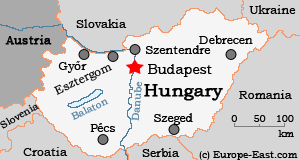
| Clickable Map of Hungary |
Hungary covers an area of 93,030 km² - 2/3 of the size of England and as big as Indiana.
The population is slightly more than 10 million* (2003) - almost the same is London Metropolitan Area.
Almost 90% are ethnic Hungarians. Minorities incl. Roma (4%, est.), Germans (2.6%), Serbs (2%), Slovaks (0.8%), Romanians (0.7%) and others. There's a remarkably large Hungarian community living abroad.*
Religion
Around 2/3 are Roman-Catholic, some 20% Calvinists, 5% Protestants and others*.
Time zone
As in middle Europe: GMT +01 hr, with daylight-saving time (+1 hour) in summer.
*Source: CIA World Factbook
Hungarian (Magyar). This language belongs to the Finno-Ugric language group, namely a branch of the Uralo-Altaic language family. This means, that Hungarian has absolutely nothing to do with Indo-European languages such as English, German, Spanish etc. Which is bad news for the traveler. As a matter of fact, Hungarian is an agglutinative language, ie parts of words are combined into long sequences to form sentences. Other languages belonging to the same language family (distantly!) include Finnish, →Turkish and according, to some theories, →Japanese as well as →Korean.
The Hungarian language features distinctive gimmicks such as the so-called vowel harmony. This means, that endings correspond with the syllables standing in front of the ending. It includes certain pronunciation patterns, which are difficult to learn (interestingly, →Slovakian - a Slavic language, which was heavily influenced by Hungarian - has something similar). However, note that the author of this website doesn't really have a clue about Hungarian.
The good news is that Latin script is used. Unfortunately, the pronunciation is often completely different. Additionally, there are some consonant combinations counting as single sounds. Which means, that for example cs- counts as a single letter. Therefore, words or names starting with 'cs' are not written between c and cytries in dictionaries, phone books etc, but after the letter c. E.g., first comes 'c-' to 'cy-', then 'csa-' and so on. Therefore I want to provide a short overview of typical Hungarian consonants and combinations:
- C is always pronounced as the [ ts ] in [ tsar ]
- Cs is pronounced as the [ ch ] in [ coach ]
- Gy is pronounced as the [ dy ] in [ Goodyear ]
- J and Ly are both pronounced as the [ y ] in [ yes ]
- ny is pronounced as the Spanish [ ñ ] in [ cañon ]
- S is always pronounced as the [ sh ] in [ ship ] (!!!)
- Sz is pronounced as the [ s ] in [ sing ]
- Ty is pronounced as the [ tu ] in [ tune ]
- Zs is pronounced as a voiced 'sh', ie as the [ s ] in [ vision ] .
Of course, Hungarian doesn't only consist of consonants. As with the vowels, it's absolutely necessary to be aware of the accents, ie small marks atop the vowels:
- a is mostly pronounced as the open [ o ] in [ god ], á on the other hand is pronounced as the [ a ] in [ arm ], but shorter.
- e Is pronounced as a short [ e ], as for example in [ get ]. é is a long [ e ] as for example the [é] in [ café ].
- i is a short [ i ] as in [ fit ]. Therefore, í is a long [ i ] as the [ ee ] in [ meet ].
- o is a short [ o ] as the [ o ] in [ north ] (but shorter!), ó is similar to the [ o ] in [ north ].
- ö is similar to the German o-umlaut, close to the [u] in [ fur ] but shorter, ő (o with two long diagonal strokes) is the long version of [ ö ]. Since many computers cannot display this character, it is often written as [ õ ].
- u is pronounced as a short [ u ] - close to the [ oo ] in [ foot ]. Hence, ú is pronounced as the [ oo ] in [ food ].
- ü is similar to the German u-umlaut, close to the French [ u ] as in [ parvenu ]. Logically, ű is the long form of it. The latter is not often used in Hungarian.
Especially the umlauts are excessively used. Knowing the correct pronounciation is extremely helpful - how else would it be possible to get a train ticket to →Pecs for example when you don't know that it's pronounced [ pairch ]? Hungarians are used to the wrong pronounciation of [ Budapest ] (correct: Budapesht), but in the countryside it might get difficult. Many Hungarians speak English very well. But not seldomly it's only German that can help you.
Gerald Kisabeth wrote:
I am looking for some much needed help. My wife & I are visiting Hungary & Slovakia & will rent an auto in Kosice Slovakia for a few days. Every auto rental told us that we cannot drive the car into the Ukraine. My wife's grandparents were from 2 small villages just into the Ukraine near the larger cities of Uzhhorod & Mukacheve. We have a friend that would meet us and take us to the villages. My question: is there a Hungary-Ukraine border town close to Uzhhorod where we can stay & leave the auto for just 1 day trip.
Thanks & I would appreciate hearing from anyone with their thoughts.
Our friend does not want to cross over to Hungary to pick us up. Also my wife would love to see the villages but she is afraid & thinks the Ukraine officials are like the old KGB!!!
Thanks from Gerald in Canton, Michigan USA
Posted by Gerald Kisabeth on January 22, 2009 23:21
©2024 Europe-East.com
